
Why Medical Practices in Macomb and Oakland County Don’t Show Up on Google, and How to Fix It
Medical practices across Macomb County and Oakland County invest heavily in patient care, staffing, equipment, and compliance, yet many face the same frustrating issue: local patients cannot find them online. Even established practices with strong reputations often fail to appear in Google search results or Google Maps when patients search for care nearby.
This is not a reflection of the quality of care being provided. It is almost always the result of how local visibility works online and how medical practices are typically marketed. In a business environment where patients increasingly search for providers on their phones before making decisions, being invisible online directly impacts appointment volume, case mix, and long-term stability.
How Patients Choose Doctors Today in Macomb and Oakland County
When someone needs an eye exam, dental work, primary care, dermatology, physical therapy, or any other consumer-facing medical service, the journey usually starts in one of two places: Google Search or Google Maps.
Patients are asking themselves questions they might not even realize they are asking: Does this place look established? Does it look safe? Is it easy to find what is offered? Does it feel current? Does it feel personal? Does it feel like the staff and doctors are real people?
The practices that win that moment are not always the most clinically impressive. They are the ones that look clear, current, easy to understand, and locally trusted.
Trust Is Formed Before the First Phone Call
Healthcare is not an impulse purchase. Patients want reassurance. They want clarity. They want to feel that a practice is organized and modern enough to take care of them properly. The website and online presence act as a proxy for the experience they expect inside the office.
A website that loads slowly, breaks on mobile, or has outdated formatting creates hesitation. Broken links create doubt. Confusing navigation creates frustration. A low review count creates uncertainty. An email address like @sbcglobal.net, @yahoo.com, or @hotmail.com can create a subtle concern about professionalism and security.
None of these issues require the patient to say it out loud. They simply click back, choose another option, and the practice never even knows an opportunity was lost.
Why Stock Photos and AI Content Reduce Trust in Healthcare Marketing
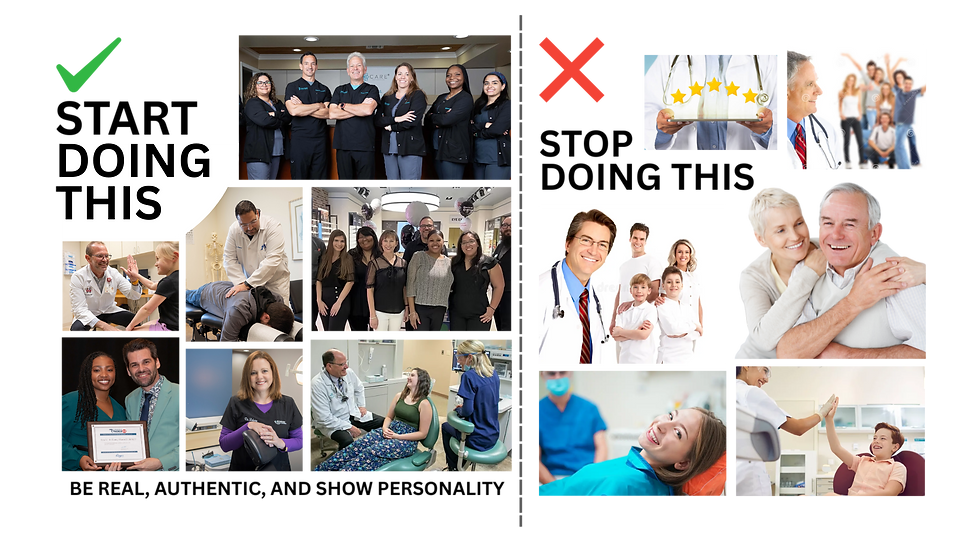
One of the most common issues across older medical websites is the use of generic imagery. Stock photos of smiling families, overly staged “doctor” images, and generic medical office scenes are everywhere. The public recognizes this instantly, even if they cannot articulate why it feels off.
It signals distance. It signals templated marketing. It does not build connection.
Patients want authenticity, especially when the service involves their health, their vision, their pain, their child, or their finances. They do not need perfect photography. They need real.
They want to see the actual doctor, the actual staff, the actual office, and the real environment they will walk into. A modern patient expects that level of transparency, even subconsciously.
The same is true with AI-generated content. AI can produce writing quickly, but “quick” is not what patients are looking for in healthcare. Patients sense when language feels generic, overly polished, or emotionally hollow. When every sentence sounds like it was generated from a template, it reduces perceived value.
In healthcare, perceived value matters. When the public sees low-effort visuals and generic wording, the practice can feel cheap even if the care is premium. This is one of the fastest ways a strong practice gets mis-positioned in the patient’s mind.
Technical Issues That Quietly Hurt Medical Practices Online
Many practices are unaware of how often small technical issues quietly sabotage conversions and local visibility. These issues typically fall into a few categories.
Website Security and HTTPS

If a website is not served over HTTPS, modern browsers may flag it. Even when the warning is subtle, patients notice it. If a site looks unsecure, it creates the impression that the practice is behind the times. In a world where everyone is aware of data breaches, the subconscious question becomes, “If the website is unsecure, how are they handling my information?”
Slow Load Times and Mobile Performance Failures
Websites that fail to load quickly, especially on mobile, lose people immediately. Many older sites were built for desktop browsing and were never optimized for mobile performance. Some fail to load correctly on newer phones. Some break when forms are submitted. Some take long enough that the user gives up and chooses another practice.
Broken Links, Outdated Pages, and Irrelevant URLs

When a website sends patients to dead pages, outdated PDFs, or a “Google Reviews” button that does not actually open the reviews, the impression is neglect. It tells the patient the practice is not maintaining its public-facing presence. That is not what someone wants to feel right before trusting a medical provider.
Irrelevant URLs can also create confusion and reduce trust. If a link appears unrelated to what the patient is trying to accomplish, it adds friction and uncertainty in the decision process.
Outdated Email Addresses and Patient Communication Risk

When a practice uses an ISP-based email address or legacy consumer email for patient communication, it can appear insecure and outdated. Patients may not understand the technical differences, but they often feel the difference. It impacts perceived professionalism, privacy confidence, and operational maturity. In many cases, a professional domain email is a small change that sends a much stronger message about credibility and security.
Website Navigation and User Experience Problems That Cost Appointments
In many cases, a patient does not leave because the practice looks bad. They leave because they cannot find what they need quickly.
Patients want answers without effort. If it is difficult to find services, hours, insurance, location, doctors, appointment booking, or contact information, many users will not keep searching. They will return to Google and click the next option.
This is where customer psychology matters. Most people do not behave like careful researchers. They behave like someone trying to reduce uncertainty fast. A clear website reduces uncertainty. A cluttered website increases it.
Google Maps and Reviews: The Local Ranking Factors Practices Ignore
Local patient acquisition is heavily influenced by Google’s local ecosystem. For most practices, Google Maps is not a secondary channel. It is a primary funnel.
Patients look at three things first: proximity, ratings, and review count. A practice with a 4.9 rating but only a handful of reviews can lose to a competitor with a slightly lower rating but a much higher volume of reviews. That is not because patients are irrational. It is because volume signals confidence and consistency.
Low Review Volume and Low Star Ratings

Many practices either have low ratings or very few reviews. Some have strong reviews, but they are not consistently growing in quantity. Some are not asking patients at the right moments. Some do not have a process that makes leaving a review easy.
Regardless of the reason, the patient’s perception is the same. Low volume creates uncertainty, and uncertainty pushes patients toward the competitor that looks more established online.
Review Links That Do Not Go to the Actual Google Profile

Some websites include buttons that claim to link to reviews, but the link is broken or points somewhere else. From the patient’s perspective, this creates frustration. From Google’s perspective, it is another signal that the online ecosystem is not well maintained.
A review link should take a user directly to the correct Google profile, consistently, every time.
Google Business Profile Completeness and Category Selection
Many practices have a Google Business Profile, but it is not fully optimized. Missing service details, poorly written descriptions, incorrect categories, or outdated information can reduce visibility.
Google wants clarity. If it cannot confidently understand what a practice offers, it is less likely to rank it for the searches that matter most.
Consistency of Name, Address, and Phone Across Listings
Inconsistent business information across directories weakens trust signals. Even small differences can create confusion for both search engines and patients. Consistent listings act like reinforcement. Inconsistent listings act like noise.
Why Many Practices Do Not Rank on Page 1 or 2 in Local Google Search
A very common scenario is a good practice that simply does not rank well. It is not visible on the first page, and often not even on the second page, for the services it provides.
This is usually not because the practice is unknown. It is usually because the website does not clearly match modern search intent. Many older websites have generic pages with generic language, weak location signals, and little structured relevance.
Missing Location Relevance (County and City Signals)
If a website does not clearly indicate where a practice is located and what areas it serves, Google has less confidence in showing it for local searches. Location relevance is not about repeating city names unnaturally. It is about creating clear, helpful context that matches how patients search in real life.
Thin or Generic Service Pages
Many medical websites describe services in vague terms. Patients search using specific language. When service pages do not reflect what people actually type into Google, those pages struggle to rank.
Service pages should clearly explain what is offered, who it is for, and what a patient should do next. They should also reinforce local relevance in a natural, professional way.
Website Structure That Google Cannot Interpret Correctly
Websites with messy architecture, outdated frameworks, broken internal links, and unclear page hierarchy can be difficult for search engines to interpret. Even if the content is good, poor structure can prevent visibility.
Clean structure is not a cosmetic preference. It is a ranking factor.
Modern Medical Website Design: Credibility Infrastructure, Not Decoration
Design should not be viewed as decoration. In healthcare, design is credibility infrastructure.
Modern patients associate modern presentation with operational competence. That does not mean a practice needs trendy design. It means the site needs clarity, clean formatting, readable typography, modern spacing, consistent branding, and real imagery.
When a website still feels like the mid-2000s, patients do not interpret it as “old fashioned.” They interpret it as “not maintained.” That creates the wrong emotional response.
The biggest design issues that cause trust loss are usually simple: outdated formatting, hard-to-read text, unclear menus, poor mobile layouts, too much information on one page, and generic photos that do not create connection. These issues can make even a premium practice look low-end.
What Actually Works for Medical Marketing Today
For most consumer-facing medical practices, marketing is not primarily about social media. Social media can help, but it is not where high-intent patients start. High-intent patients search.
This is why the most reliable path to consistent local patient acquisition is built around local search visibility, Google Maps presence, and a website that converts.
A modern approach typically emphasizes three outcomes.
First, the practice can be found locally when patients search for the right services.
Second, the practice looks credible and personal when patients land on the website or Google profile.
Third, the patient can act quickly by calling, booking, or contacting without friction.
When these outcomes are present, the practice can reduce dependence on paid ads and reduce the pressure to constantly post on social media just to feel active.
Existing Client - Click to view Google My Business page:

When Starting From Scratch Is the Smartest Move
Some websites are not outdated in a cosmetic way. They are outdated structurally. They were built in a different era with different standards, and patching them can become a never-ending cycle of small fixes that still fails to meet modern expectations.
If the website has broken infrastructure, irrelevant URLs, poor mobile performance, and technical issues that prevent proper loading or indexing, starting fresh is often more efficient and more reliable.
A modern rebuild does not mean reinventing the brand. It means rebuilding the foundation so the practice can compete locally again, communicate securely, and convert online interest into appointments.
For practices that have not meaningfully updated their site since the mid-2000s, a rebuild is less about marketing and more about infrastructure, the same way a practice invests in equipment upgrades and operational improvements over time.
What a Modern Local Presence Looks Like in Metro Detroit
A modern local presence is straightforward. When done correctly, it feels calm, professional, and human.
The practice shows up in Google Search and Google Maps for the services it actually provides in the local area it actually serves. The Google profile is accurate, complete, and consistent. Reviews are present, legitimate, and easy to access. The website loads quickly, works on mobile, and makes it easy to find the information a patient needs. The visuals feel real and relevant. The content is clear and avoids generic filler. Communication looks professional and secure.
Most importantly, the patient feels reassured without having to think about why.
Final Perspective for Owners and Doctors in Macomb and Oakland County
Many practice owners and doctors did not choose medicine because they wanted to manage websites, listings, SEO, security, and patient psychology. Running a medical operation already requires constant attention, staffing management, compliance, and patient care.
The challenge today is that visibility and trust are no longer optional. They are part of the infrastructure of patient acquisition, just like scheduling systems, phone systems, and insurance workflows.
For medical practices in Macomb County and Oakland County, the practices that win locally are not always doing more. They are removing friction, modernizing credibility signals, and making it easier for patients to choose them with confidence.


